Tell us about the job
Takes about a minute. No obligation.

A mini-split repair in Scott County starts with a question a contractor has to settle before ordering parts: what actually caused the failure. 137 severe weather events were recorded in Scott County, Minnesota between 2015 and 2024. At that rate, cumulative load on compressors, refrigerant lines, and electrical components is a real factor, not a stretch. A contractor will look at whether wear patterns match weather stress or ordinary age, because those two causes often point to different fixes and different bills.
Scott County's housing stock is recent enough that a mini-split repair here is decided by what a contractor finds inside the unit, not by what the walls around it were built for. Half the homes in Scott County, Minnesota were built in 1997 or earlier (2020-2024 ACS 5-year). Equipment running in houses of that age was installed into construction that was already compatible with it, so the refrigerant lines, the mounting, and the electrical are seldom the problem. What drives the repair scope is the condition of the compressor, the control board, and whether the manufacturer still stocks the parts a system of that specific model takes.
The Parts of a Mini-split a Contractor Checks First
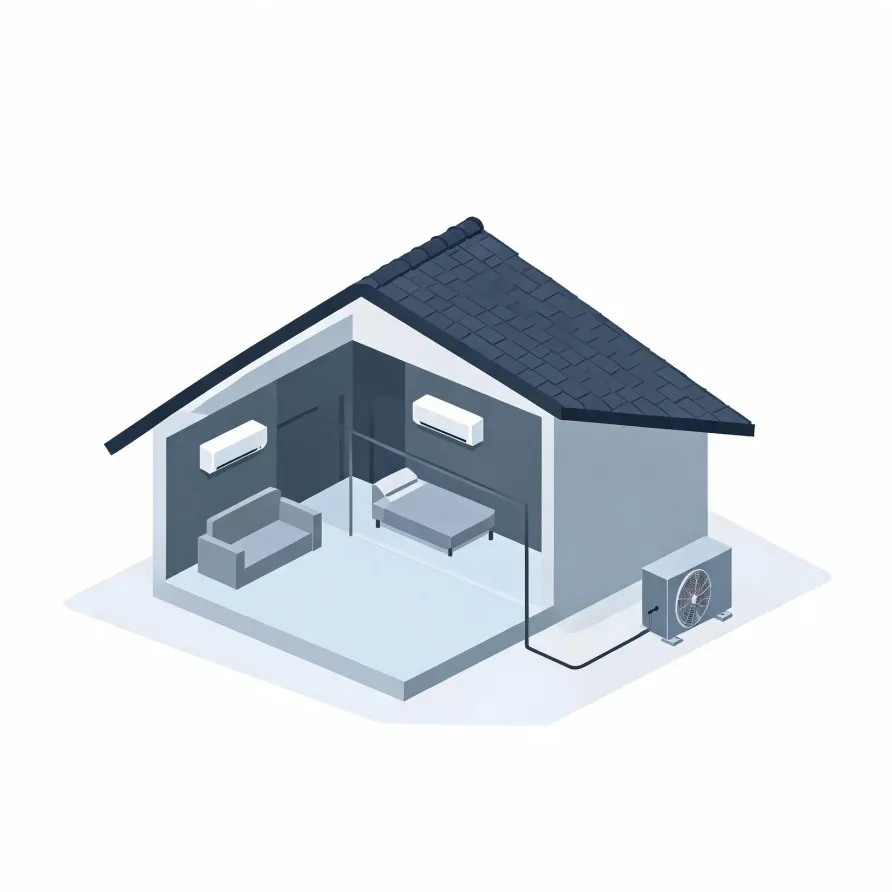
The indoor air handler mounts high on a wall inside the room and is the piece a homeowner notices most. It pushes conditioned air into the space and pulls room air back across its coil and filter. When airflow drops, temperatures swing, or the unit leaks water, the handler is where a contractor starts.
The outdoor condenser sits outside the house and holds the compressor and the main coil. A refrigerant line set runs between the two units through a small opening in the wall, carrying the working fluid that lets the system do its job. The condenser and the line connections are common sources of faults when the system loses capacity or stops responding.
The drawing shows the general layout of a mini-split system, and a licensed contractor determines what applies to your specific installation.
Get matched in Scott CountyScott County, by the numbers
137 severe weather events were recorded in Scott County, Minnesota between 2015 and 2024.
NOAA National Centers for Environmental Information, Storm Events Database, bulk CSV export, events 2015-01-01 through 2024-12-31.Half the homes in Scott County, Minnesota were built in 1997 or earlier (2020-2024 ACS 5-year).
U.S. Census Bureau, 2020-2024 American Community Survey 5-Year EstimatesScott County, Minnesota holds 56,671 housing units (2020-2024 ACS 5-year).
U.S. Census Bureau, 2020-2024 American Community Survey 5-Year EstimatesOwners occupy 83.8% of the occupied homes in Scott County, Minnesota (2020-2024 ACS 5-year).
U.S. Census Bureau, 2020-2024 American Community Survey 5-Year EstimatesCodes & Standards Governing Mini-Split Repair in Scott County, Minnesota2 sourced rules and standards
Contractor Rules in Scott County, Minnesota
Minnesota defines a mechanical contractor as a business that installs, repairs or maintains heating, ventilating, cooling or refrigeration systems — the definition that carries the exemption from the residential contractor licence.
Minnesota's residential contractor licence does not reach HVAC work: the licensing section carries its own exemption list, and a mechanical contractor is exempt from the licence requirement by name.
Severe Weather Events in Scott County, Year by Year
Extreme weather puts real hours on heating and cooling equipment. In Scott County, that workload shapes how hard a mini-split has to run and how often its components are pushed to their limits, which makes local weather history a practical backdrop for any conversation about repair.
137 severe weather events, 2015–2024. Source: NOAA National Centers for Environmental Information, Storm Events Database.